HEPA Air Scrubbers: What They Do During Mold Removal
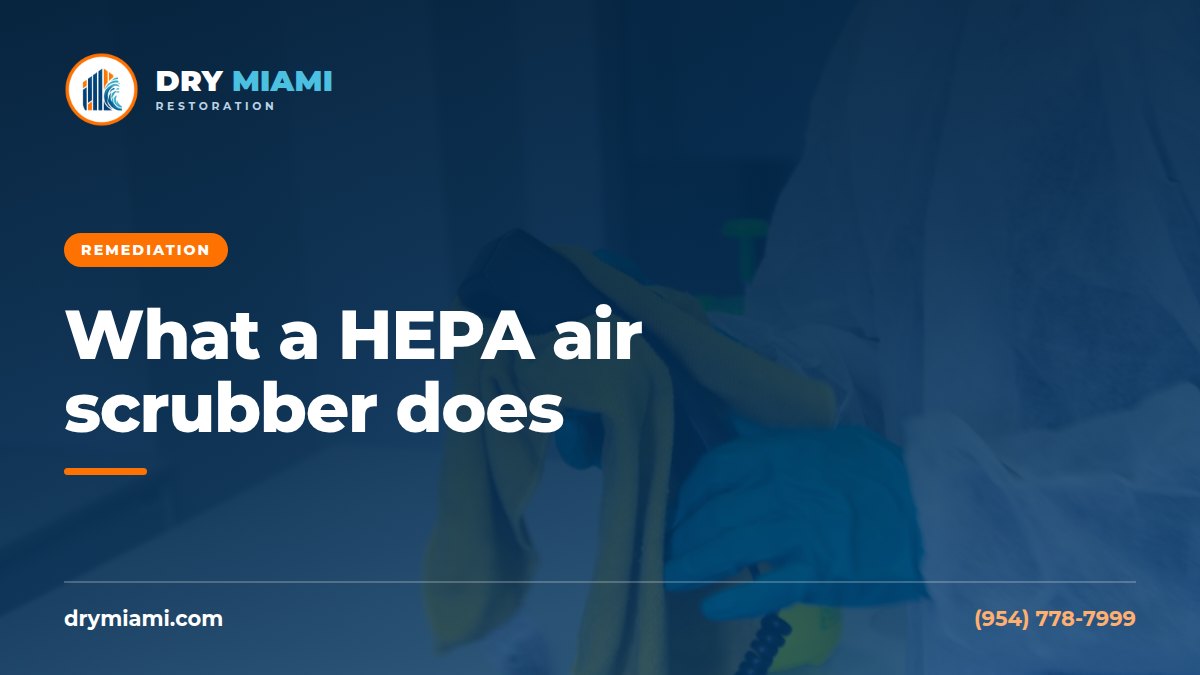
If you have ever walked past a mold job in a Miami condo hallway, you have probably heard it before you saw it: a steady hum coming from a boxy machine with a fat flexible duct attached. That is a HEPA air scrubber, and it is one of the most misunderstood pieces of equipment in remediation. It is not a mold killer and it is not a fancy air purifier. It has one specific job, and knowing what that job is helps you judge whether the work in your home is being done properly.
What a HEPA air scrubber is
An air scrubber is a portable fan cabinet that pulls room air through a stack of filters and pushes the cleaned air back out. The filter that matters is the last one. A true HEPA filter is rated to capture 99.97 percent of particles at 0.3 microns, the size that is hardest to trap. Mold spores and the fragments that break off moldy drywall are generally larger than that, so a sealed, properly seated HEPA filter catches them very effectively.
Ahead of the HEPA filter sit one or two cheaper prefilters. They catch drywall dust and lint so the expensive filter does not clog in the first hour. Some units also hold an optional carbon filter, which helps with musty odor but does nothing for spores.
Why it is needed during removal
Mold sitting undisturbed on the back of a baseboard releases relatively little into the air. The moment someone cuts that drywall, pulls the baseboard or scrubs a stud, the count of airborne particles in that room climbs sharply. Demolition is the dirtiest moment of the whole project.
The scrubber runs through that phase and afterward, cycling the air in the work area over and over so that what gets knocked loose ends up in a filter instead of settling on your sofa or drifting into the return grille of your AC. In South Florida, where the air handler runs nearly every day of the year, that second point matters a great deal: an unprotected return can carry dust from one room to every room.
Scrubbing versus negative air
The same machine can be used in two different ways, and crews often use both on one job.
- Recirculating, or scrubbing: the machine sits inside the work area and blows filtered air back into the same space. It lowers the particle load but does not control which way air moves.
- Negative air: a duct carries the filtered exhaust out of the contained area, usually through a window or door panel. The work area ends up at slightly lower pressure than the rest of the home, so air leaks inward rather than outward.
A scrubber alone, with no plastic containment around the work area, is only half a system. It cleans air, but it cannot stop dust from walking out the doorway.
What a scrubber cannot do
This is where marketing tends to get ahead of the facts. An air scrubber does not:
- Remove mold growing on or inside materials. Colonized drywall, carpet pad and insulation still have to be cut out and bagged.
- Fix the leak, condensation or humidity problem that caused the growth.
- Clean settled dust. Surfaces still need HEPA vacuuming and damp wiping.
- Replace source removal. Running a machine for a week in a room with moldy walls leaves you with moldy walls.
It is also not the same as an ozone generator or a fogger. Those are different devices with different claims, and neither is a substitute for filtration and physical removal.
How to tell if it is being used well
You do not need to be a technician to spot the basics. Look for these during the job:
- The machine is running before demolition starts, not switched on afterward.
- The work area is sealed with plastic sheeting, and supply and return vents inside it are covered.
- Prefilters look reasonably clean. A prefilter caked gray with dust chokes airflow.
- The unit is sized to the space. One small scrubber in a large open living area will struggle; crews add machines for bigger rooms.
- It keeps running through the final cleaning and for a period afterward, rather than leaving with the last trash bag.
Expect noise, roughly like a loud box fan, and a small bump in your electric bill for the days it runs. Leave it on overnight unless the crew tells you otherwise. Turning it off to sleep undoes part of the reason it is there.
The bottom line
A HEPA air scrubber is a supporting player: it keeps the mess of removal from spreading while the real work, cutting out damaged material and cleaning what remains, gets done. If you want to know what equipment and containment your situation calls for, request an on-site remediation estimate at drymiami.com or call (954) 778-7999. The visit is $79, credited in full toward the job if you hire DryMiami.
Mold problem at home?
We come out, find the moisture source and give you a written remediation estimate. The visit is $79, credited in full toward your job if you hire us.